My current research centers on generative AI, with particular interests in world models and image/video/3D generation. I am also interested in multimodal understanding and its connections to generative modeling. Before moving into generative modeling, I worked on multi-view learning. If you are working on similar topics, I would be happy to exchange ideas and explore potential collaborations. Feel free to reach out via 📧 xinyupu02@gmail.com or 💬 .
Research interests:研究兴趣:Generative AI, Image/Video/3D Generation, World Models, and Multimodal Understanding.生成式人工智能、图像/视频/三维生成、世界模型与多模态理解。
I am seeking Ph.D. opportunities starting in Fall 2027 in these areas. If my background and research interests align with your group, I would be grateful for the opportunity to discuss potential Ph.D. positions.
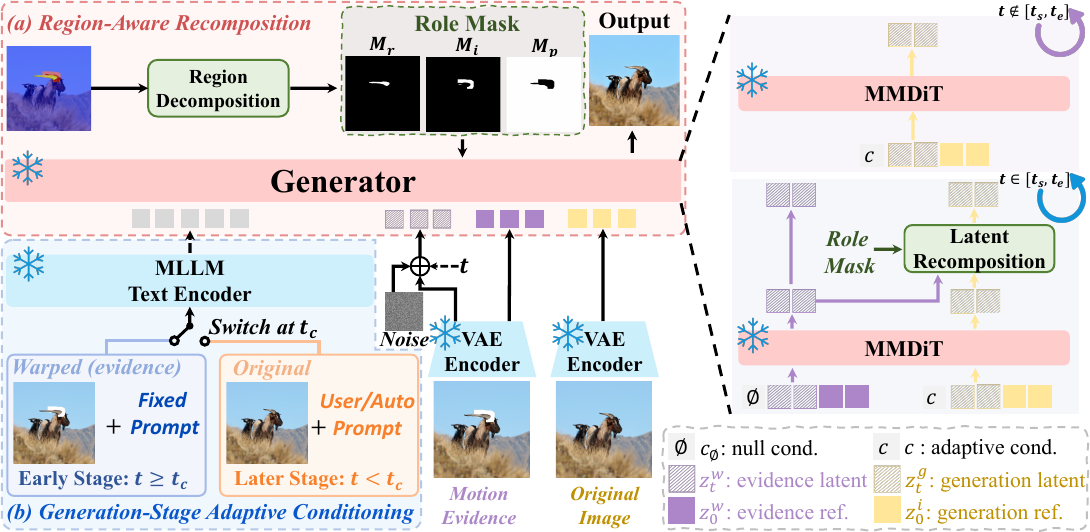
Drag as Evidence: Motion-Grounded Latent Recomposition for Drag-Based Editing
Xinyu Pu, Hongsong Wang, Jie Gui, Pan Zhou
NeurIPS 2026|Advances in Neural Information Processing SystemsCCF-ACORE-A*
Abs摘要
Modern image editors excel at semantic manipulation and visual synthesis, yet remain limited in precise spatial control, motivating the development of drag-based editing. However, existing drag-based methods often struggle to balance drag accuracy with natural, plausible, and intent-aligned generation. We propose MoRe-Drag, a motion-grounded drag-based editing method. Our key insight is to treat pixel-space warping as coarse motion evidence, and to inject this evidence into the generative sampling trajectory. Specifically, MoRe-Drag performs region-aware latent recomposition over refinement, inpainting, and anchor regions, coupled with stage-adaptive conditioning that progressively shifts from motion-grounded structure formation to semantic refinement. We further support an instruction-free interface by adapting the MLLM-based text encoder for drag-aware instruction inference. Experiments on DragBench-SR and DragBench-DR show that MoRe-Drag substantially improves drag precision over strong base editors and achieves superior drag accuracy among SOTA drag-based methods, while delivering strong semantic consistency and visually realistic results. Code and dataset will be publicly released.
A little swamped right now :( — paper and code coming soon.最近有点忙 :(,论文和代码整理中,会尽快放出。
ICLR 2026|International Conference on Learning RepresentationsCCF-ACORE-A*
Abs摘要
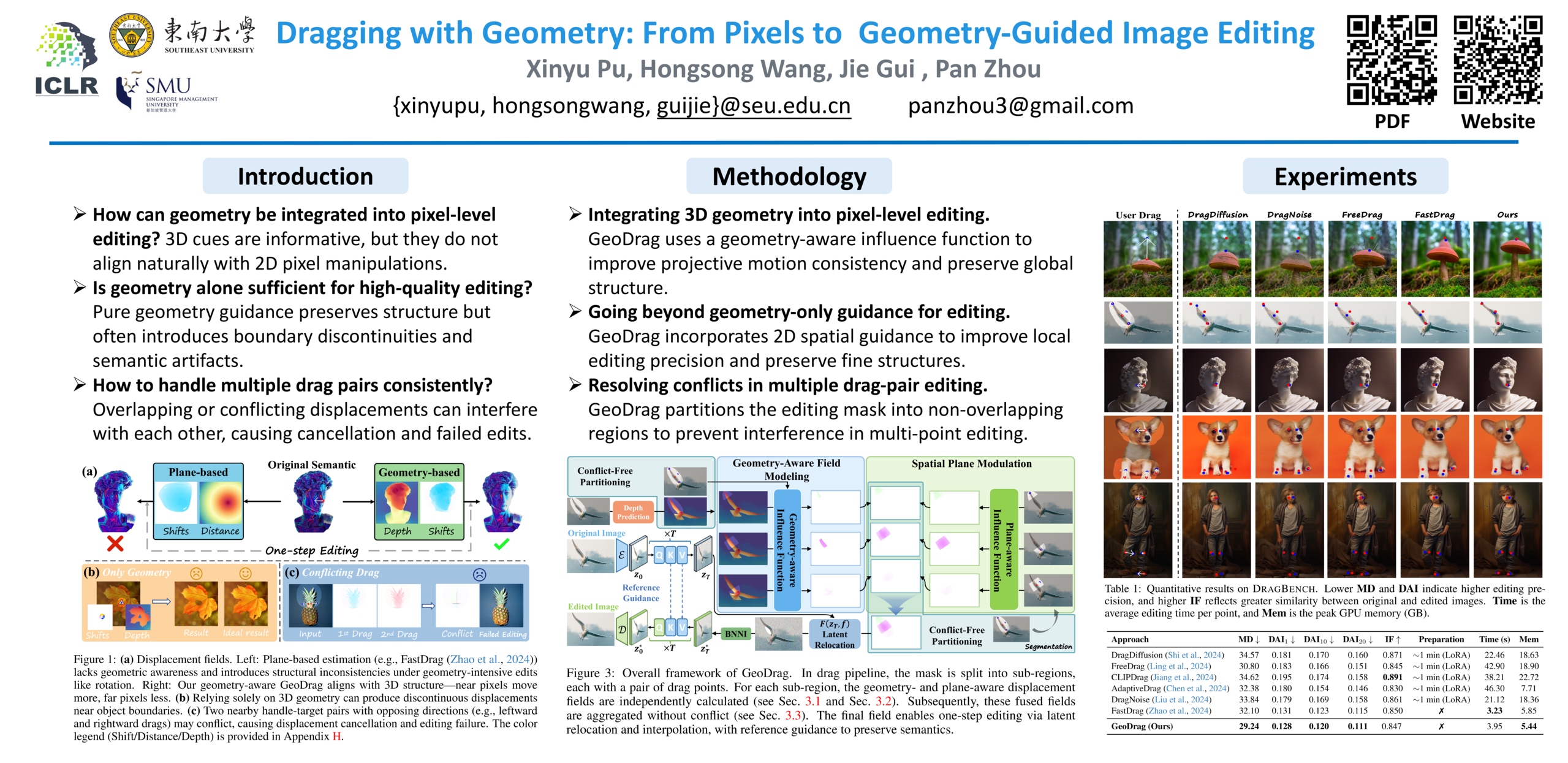
Interactive point-based image editing serves as a controllable editor, enabling precise and flexible manipulation of image content. However, most drag-based methods operate primarily on the 2D pixel plane with limited use of 3D cues. As a result, they often produce imprecise and inconsistent edits, particularly in geometry-intensive scenarios such as rotations and perspective transformations. To address these limitations, we propose a novel geometry-guided drag-based image editing method—GeoDrag, which addresses three key challenges: 1) incorporating 3D geometric cues into pixel-level editing, 2) mitigating discontinuities caused by geometry-only guidance, and 3) resolving conflicts arising from multi-point dragging. Built upon a unified displacement field that jointly encodes 3D geometry and 2D spatial priors, GeoDrag enables coherent, high-fidelity, and structure-consistent editing in a single forward pass. In addition, a conflict-free partitioning strategy is introduced to isolate editing regions, effectively preventing interference and ensuring consistency. Extensive experiments across various editing scenarios validate the effectiveness of our method, showing superior precision, structural consistency, and reliable multi-point editability. Project page: https://xinyu-pu.github.io/projects/geodrag.
Xinyu Pu, Hangjun Che, Deqiang Ouyang, Shouxi Zhao
IEEE TMM 2026|IEEE Transactions on MultimediaCCF-ASCI-Q1
Abs摘要
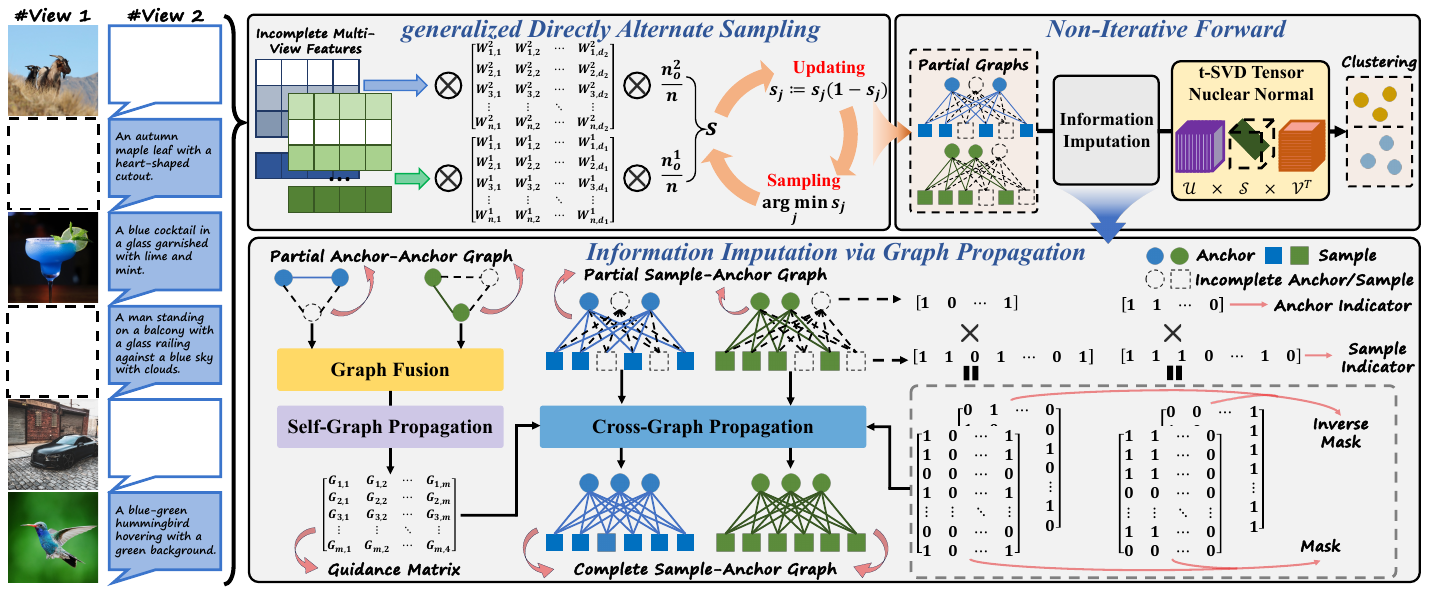
Recently, incomplete multi-view clustering has emerged as a powerful solution for discovering consistent cluster structures despite the presence of missing views. When handling incomplete data, existing methods usually reconstruct missing features from observed views or estimate similarities from known inter-sample relationships, yet they often fail to balance clustering performance with computational efficiency. Although anchor graph learning has shown strong effectiveness in multi-view clustering, its extension to incomplete scenarios remains a non-trivial challenge. Furthermore, the reliance on iterative optimization involving coupled variables significantly hinders the scalability of existing models. In response to these challenges, we propose SSR—a method designed for scaling, simplifying, and robustifying multi-view clustering. SSR introduces a scalable framework empowered by a novel anchor selection strategy tailored for incomplete multi-view data. In this framework, graph propagation is employed to impute missing information, enabling effective information diffusion across views. In contrast to traditional methods that rely on computationally intensive iterative optimization, SSR adopts a forward-only, low-complexity design, significantly enhancing scalability. Moreover, isolation masks are incorporated into the graph propagation process to improve robustness. Extensive experiments on multiple datasets demonstrate the superior clustering accuracy and computational efficiency of SSR, establishing it as a practical and efficient solution for multimedia analysis in real-world scenarios.
Hangjun Che*, Xinyu Pu*, Deqiang Ouyang, Beibei Li
ACM MM 2024|ACM International Conference on MultimediaCCF-ACORE-A*
Abs摘要
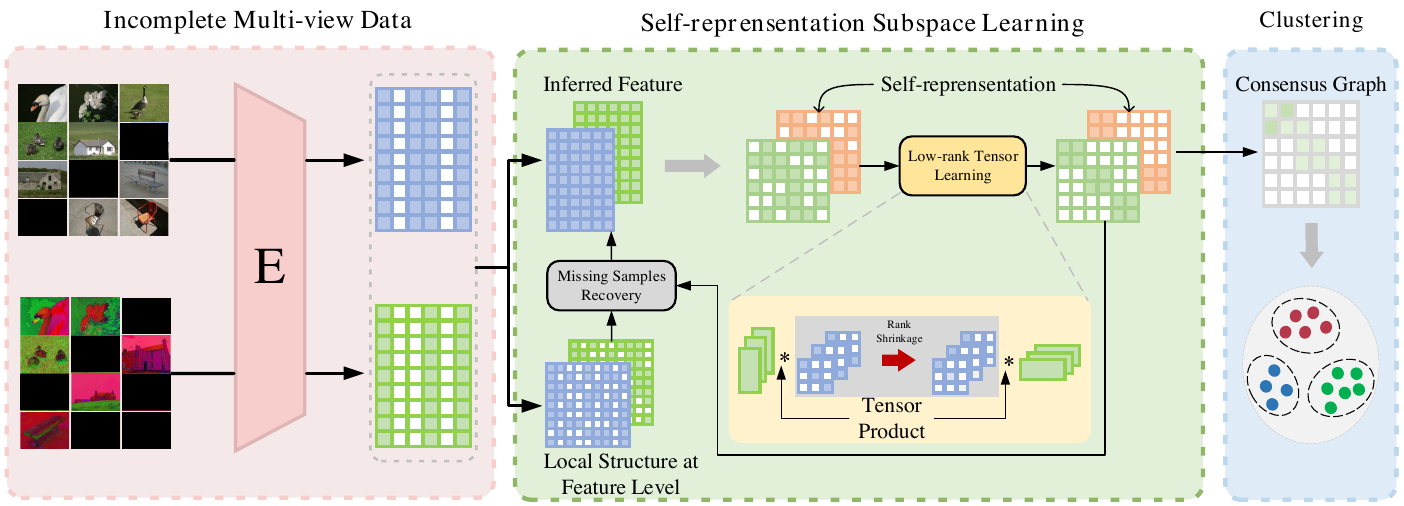
Incomplete Multi-View Clustering (IMVC) is a promising topic in multimedia as it breaks the data completeness assumption. Most existing methods solve IMVC from the perspective of graph learning. In contrast, self-representation learning enjoys a superior ability to explore relationships among samples. However, only a few works have explored the potentiality of self-representation learning in IMVC. These self-representation methods infer missing entries from the perspective of whole samples, resulting in redundant information. In addition, designing an effective strategy to retain salient features while eliminating noise is rarely considered in IMVC. To tackle these issues, we propose a novel self-representation learning method with missing sample recovery and enhanced low-rank tensor regularization. Specifically, the missing samples are inferred by leveraging the local structure of each view, which is constructed from available samples at the feature level. Then an enhanced tensor norm, referred to as Logarithm-p norm is devised, which can obtain an accurate cross-view description. Our proposed method achieves exact subspace representation in IMVC by leveraging high-order correlations and inferring missing information at the feature level. Extensive experiments on several widely used multi-view datasets demonstrate the effectiveness of the proposed method.
Xiao Zhang*, Xinyu Pu*, Hangjun Che, Cheng Liu, Jun Qin
Neural Networks 2025|Neural NetworksCCF-BSCI-Q1
Abs摘要
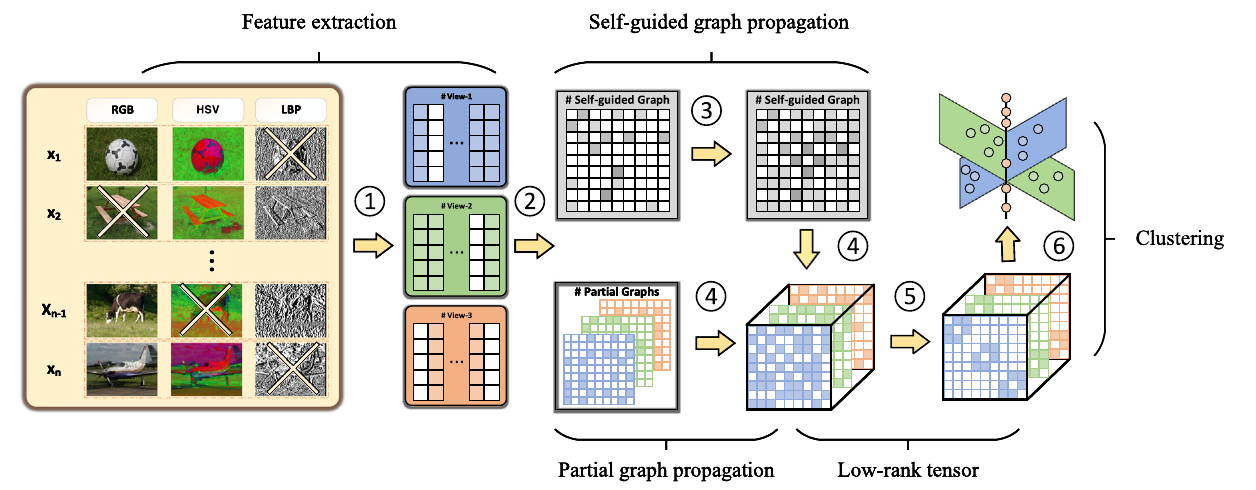
Incomplete multi-view clustering addresses scenarios where data completeness cannot be guaranteed, diverging from traditional methods that assume fully observed features. Existing approaches often overlook high-order correlations present in multiple similarity graphs, and suffer from inefficiencies due to iterative optimization procedures. To overcome these limitations, we propose a graph-based model leveraging graph propagation to effectively handle incomplete data. The proposed method translates incomplete instances into incomplete graphs, and infers missing entries through a graph propagation strategy, ensuring the inferred data is meaningful and contextually relevant. Specifically, a self-guided graph is constructed to capture global relationships, while partial graphs represent view-specific similarities. The self-guided graph is first completed through self-guided graph propagation, which subsequently aids in the propagation of the partial graphs. The key contribution of graph propagation is to propagate information from complete data to incomplete data. Furthermore, the high-order correlation across multiple views is captured by low-rank tensor learning. To enhance computational efficiency, the optimization procedure is decoupled and implemented in a stepwise manner, eliminating the need for iterative updates. Extensive experiments validate the robustness of the proposed method, demonstrating superior performance compared to state-of-the-art methods, even when all instances are incomplete.
Xinyu Pu, Hangjun Che, Baicheng Pan, Man-Fai Leung, Shiping Wen
IEEE TCSS 2023|IEEE Transactions on Computational Social SystemsCCF-CSCI-Q1
Abs摘要
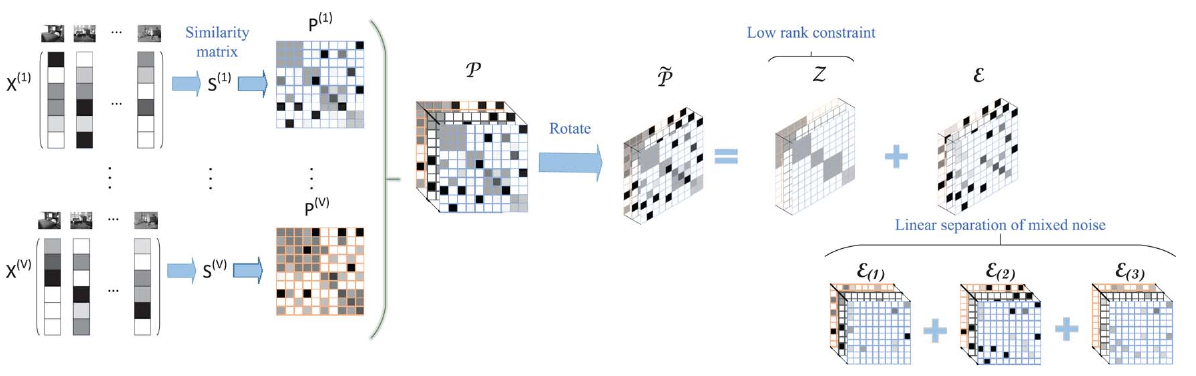
Multiview clustering performs grouping a set of objects by utilizing complementary information from multiple views. Unfortunately, the clustering performance degenerates dramatically if the views are corrupted by noise. To overcome this limitation, we propose a robust multiview clustering approach based on weighted low-rank tensor approximation and noise separation. The proposed model improves the performance through a low-rank approximation function and weighted singular values. The weighted low-rank tensor approximation method considers both prior knowledge and the physical meanings associated with different singular values, leading to superior performance in capturing high-order correlations. Additionally, to eliminate mixed noise, a novel lCauchy,1 norm is developed to handle outliers, and the l1 and Frobenius norms are used to handle random corruptions and slight perturbations, respectively. A high-efficiency optimization algorithm based on the alternating direction method of multipliers (ADMM) is designed to address the challenging proposed model. Experimental results on nine real-world datasets show that the proposed approach outperforms eight state-of-the-art multiview methods. Furthermore, experiments on various kinds of noise demonstrate the superior robustness of the proposed approach. Especially, in the mixed noise condition, the proposed approach is significantly superior to other methods.